"Michael Julian has written an excellent book. Practical, detailed, and a potential life saver if you find yourself in the midst of a targeted attack."
Active Shooter Preparedness: How to Be Ready Before It Happens
What Is Active Shooter Preparedness
Active shooter preparedness is the process of developing the awareness, mindset, and response capability needed to recognize and react to a violent threat before and during an incident.
It focuses on preparing individuals and organizations to make fast, effective decisions under pressure. Rather than relying on reaction alone, preparedness emphasizes anticipation, recognition, and action.
Active shooter preparedness is not about fear. It is about readiness.
Why Active Shooter Preparedness Matters
Violent incidents often unfold quickly and without warning. In many cases, the individuals present must respond before law enforcement arrives.
Preparedness matters because it:
- Improves recognition of potential threats
- Reduces hesitation during critical moments
- Supports faster and more effective decision-making
- Increases the ability to move toward safety
- Enhances overall survival outcomes
The first moments of an incident are often the most important.
Preparedness Begins With Awareness
Situational awareness is a key component of active shooter preparedness. It involves understanding your environment, identifying exits, and recognizing when something feels out of place.
Prepared individuals develop habits such as:
- Observing entry and exit points
- Noticing changes in behavior or environment
- Maintaining awareness in public or crowded spaces
- Avoiding distractions that limit attention
Awareness creates the foundation for action.
Planning Ahead Improves Response
Preparedness includes thinking through potential scenarios before they happen. This allows individuals to respond more quickly when faced with a real situation.
Planning may include:
- Identifying multiple exit options in familiar environments
- Understanding how to move to safer areas
- Considering how to respond in different settings such as work, school, or public spaces
- Thinking through how to assist others if needed
Mental preparation reduces uncertainty.
Training Builds Confidence and Capability
Reading about preparedness is not enough. Training helps individuals develop the ability to act under stress.
Active shooter preparedness training focuses on:
- Decision-making under pressure
- Movement and positioning
- Recognizing threats early
- Responding based on environment and conditions
- Maintaining composure during high-stress situations
Training turns knowledge into action.
Prepared Individuals Act Faster
One of the most important benefits of active shooter preparedness is reduced response time. When individuals have already considered their options and practiced their responses, they are more likely to act quickly.
Faster action can mean:
- Reaching safety sooner
- Avoiding dangerous areas
- Helping others move to safer locations
- Reducing overall risk
Preparedness shortens the gap between recognition and response.
Organizations Play a Critical Role
Active shooter preparedness is not only an individual responsibility. Organizations play a key role in creating safe environments and preparing their teams.
Organizations can support preparedness by:
- Providing professional training
- Encouraging awareness and reporting
- Developing clear emergency procedures
- Reinforcing preparedness through ongoing education
A prepared organization is more resilient.
Preparedness Is an Ongoing Process
Preparedness is not a one-time effort. As environments change and new risks emerge, awareness and training must be reinforced.
Ongoing preparedness includes:
- Regular training and refreshers
- Reviewing and updating plans
- Reinforcing awareness habits
- Ensuring new individuals are properly prepared
Consistency ensures readiness remains active.
The Takeaway
Active shooter preparedness is about being ready before a crisis occurs. It involves awareness, planning, and training that allow individuals and organizations to respond effectively when it matters most.
Prepared individuals recognize threats faster, act with greater confidence, and improve their chances of reaching safety.
A.L.I.V.E. provides active shooter preparedness training designed to develop awareness, strengthen decision-making, and equip individuals with practical survival strategies for real-world environments.
Contact us today to learn more.
About the Author
Michael D. Julian is President of MPS Security & Protection and a 30-plus-year veteran of the security and investigations industry. He served as President of the California Association of Licensed Investigators (CALI) from 2005 to 2015 and has led executive protection, residential security, and corporate investigations engagements for Fortune 500 principals, high-net-worth families, and public figures across the United States. Connect with Michael on LinkedIn.
LEARN HOW TO SURVIVE AN ACTIVE SHOOTER!
ALSO AVAILABLE FOR AUDIO DOWNLOAD, E-BOOK, AND PAPERBACK / HARDCOVER ON AMAZON




Hear From An A.L.I.V.E. Student Survivor Of The Las Vegas Massacre
"As a retired 32 year law enforcement veteran, with several years of SWAT and tactical experience, I learned some different unique perspectives as it pertains to civilians dealing with active threat situations. Very good class for civilians who may have never experienced reacting to a life and death stressful situation."
- Christopher C.
A.L.I.V.E. STANDS FOR:
Assess
Assess the situation quickly
Leave
Leave the area if you can
Impede
Impede the shooter
Violence
Violence may be necessary
Expose
Expose your position carefully for safety
INDUSTRIES WE SERVE
Corporations
Government
Healthcare
Places of worship
Schools & Universities
Venues
MICHAEL JULIAN
Creator of A.L.I.V.E.
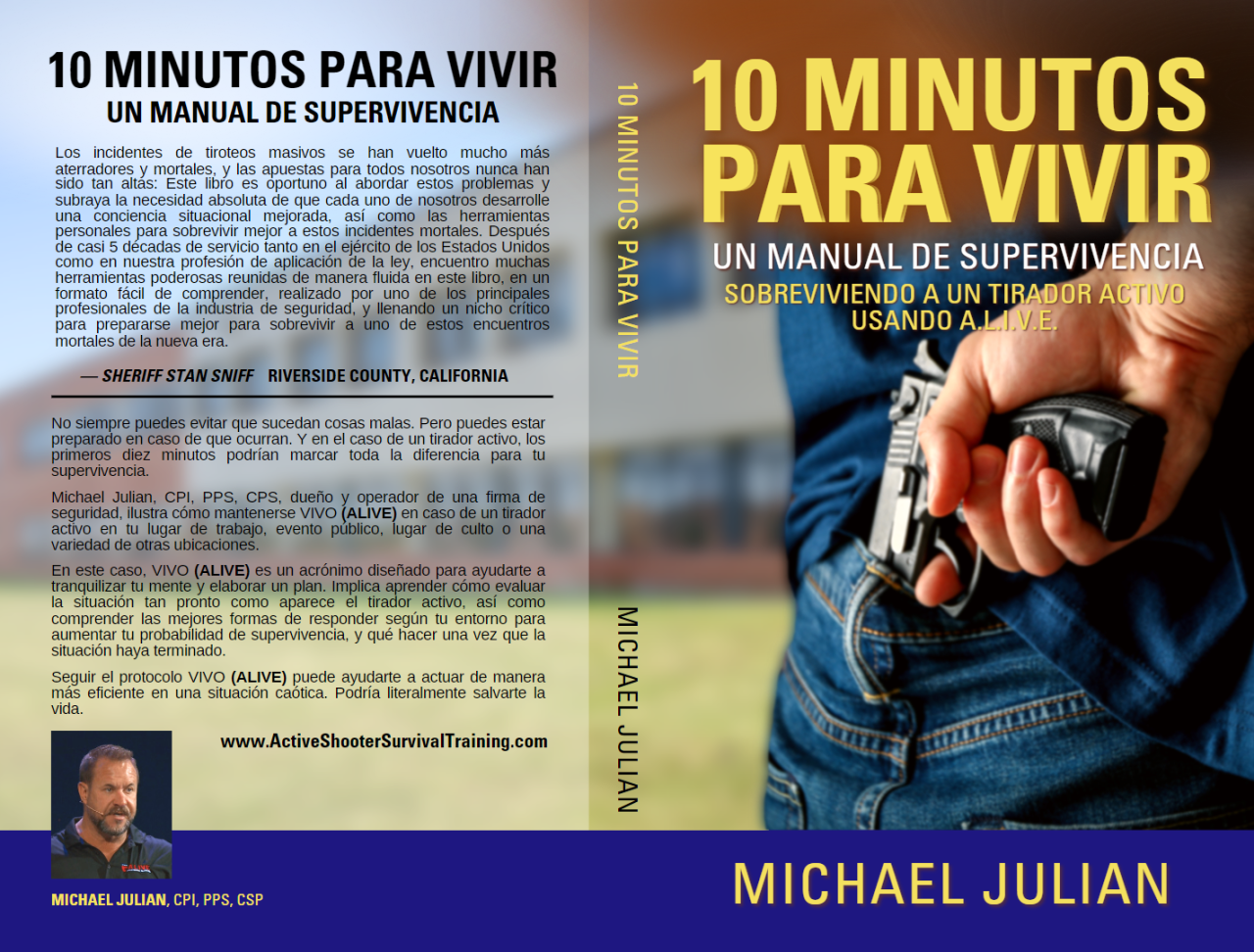
A.L.I.V.E., which stands for Assess, Leave, Impede, Violence, and Expose, was created in 2014 when Michael began teaching his Active Shooter Survival philosophy throughout the United States. His book on the subject, 10 Minutes to Live: Surviving an Active Shooter Using A.L.I.V.E. was published in 2017 and the online version of the A.L.I.V.E. Training Program was launched in 2019 and is now part of the corporate security training program for companies throughout the world.

Why A.L.I.V.E. Active Shooter
Survival Training Program?
The A.L.I.V.E. Active Shooter Survival Training Program is a comprehensive training program designed to provide individuals with the necessary skills and knowledge to survive an active shooter incident. Its emphasis on situational awareness and decision-making makes it a practical and effective approach to active shooter situations. By empowering individuals to take proactive measures to protect themselves and others, the program can help prevent tragedies and save lives.