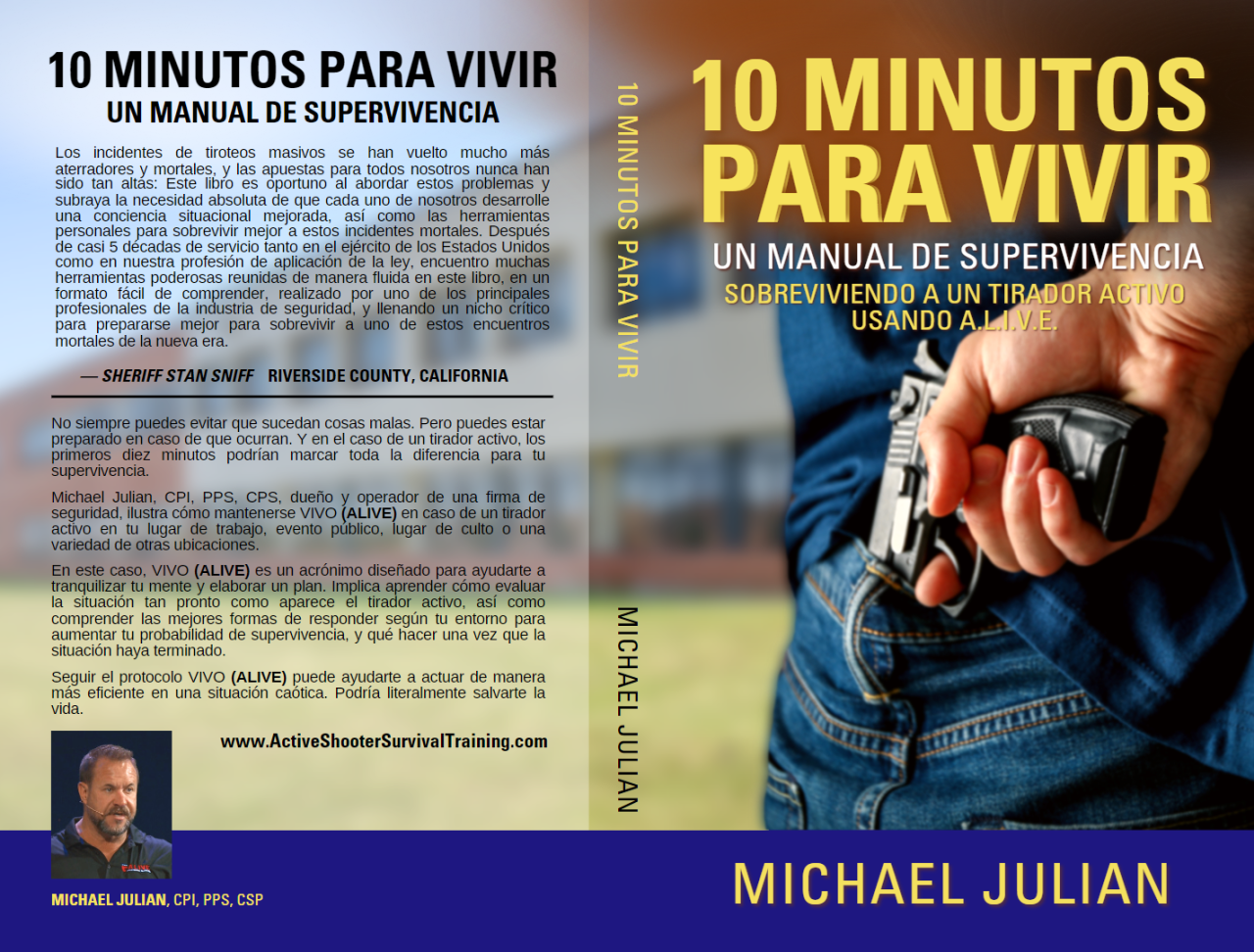
"Michael Julian has written an excellent book. Practical, detailed, and a potential life saver if you find yourself in the midst of a targeted attack."

Active Shooter Training for Property Managers: Coordinating Multi-Tenant Office Building Preparedness in 2026
Active shooter training for property managers is a coordinated preparedness program that gives commercial real estate operators - and every tenant they lease to - a single, tested response plan for a targeted-violence event inside a multi-tenant office building. In a Class A high-rise, Class B mid-rise, or business park with shared lobbies, garages, and elevators, no individual tenant can solve preparedness alone. The property manager is the only entity with line of sight across every floor, and that means the property manager owns the coordination problem.
Why multi-tenant office buildings are uniquely difficult
Single-employer facilities can write one plan, train one workforce, and run one drill. Multi-tenant buildings cannot. A 12-floor Class A office tower in Brevard County or a 200,000-square-foot business park in Burbank may house a law firm, a software company, a wealth-management practice, a medical office, and a coworking operator - each with its own HR policies, evacuation procedures, and definition of “trained.” Some tenants run an annual fire drill and call it preparedness. Others have never addressed targeted violence at all.
The shared infrastructure compounds the problem. Lobbies, parking garages, elevator banks, stairwells, and rooftop amenities all sit outside any one tenant’s footprint, which is exactly where most threats first surface. A property manager who has not built early threat detection by lobby and security staff into the building’s standard operating procedure is relying on tenants to spot and report risk indicators they have never been trained to see.
The threat picture is real. The Federal Bureau of Investigation documented 24 active shooter incidents in 2024, distributed across open spaces, commerce, education, government, and houses of worship, with 17% occurring in commerce environments - a category that includes multi-tenant office and retail properties (FBI, 2025). Workplace homicide remains a continuing risk: the U.S. Bureau of Labor Statistics recorded 740 workplace homicides in 2022 across all industries (BLS, 2023). And OSHA continues to use the General Duty Clause to cite employers - including, in some recent matters, building owners - for failing to address known workplace-violence hazards (OSHA, 2024).
What active shooter training for property managers actually covers
A well-designed program is built around the building’s actual floor plates, tenant mix, lease structure, and shared-services footprint. It does not try to retrofit a generic workplace template onto a property that has dozens of competing stakeholders.
• Building-wide response framework: a single, building-specific Alert, Lockdown, Inform, Vacate, Engage (ALICE/A.L.I.V.E.) framework that every tenant agrees to follow, communicated in lease addenda or building handbooks, so that nobody is making decisions on the fly.
• Lobby, concierge, and security desk training: front-desk staff and contracted security officers receive specific training on pre-attack indicators, refusal-of-access scripts, and lockdown initiation. They are the building’s early-warning system.
• Tenant captain program: each tenant designates a floor or suite captain who attends instructor-led training, runs internal drills, and serves as the property manager’s point of contact during an incident. This is the same model used by FEMA-aligned floor warden programs (FEMA, 2023).
• Elevator, stairwell, and garage protocols: clear instructions for what tenants do when the building goes into lockdown - which stairwells are designated egress, when elevators are recalled, how garage gates are managed, and how late-arriving employees are kept out.
• Mass notification and communication: a tested mass-notification platform (SMS, email, desk phones, public address) tied to a clear decision tree for who pushes the alert and what the message says. A poorly worded “shelter in place” message can put hundreds of people in the wrong place.
• Tenant onboarding and recurring drills: new tenants are trained within 60 days of move-in, and the entire building runs at least one tabletop exercise per year and one live walkthrough every other year, with after-action reviews shared in writing.
How to integrate training with existing emergency action plans
Most commercial property managers already maintain an Emergency Action Plan (EAP) for fire, severe weather, and medical events. The mistake is treating active shooter preparedness as a separate program. The plants and properties that get this right integrate it into the existing EAP, so that the same tenant captains, the same notification system, and the same drill calendar carry the active-shooter response.
Practical integration steps include:
• A written addendum to the building’s EAP that explicitly addresses targeted violence (not just generic emergency response).
• An instructor-led training cycle with new-tenant orientation within 60 days of lease execution and annual refreshers tied to the building’s life-safety calendar.
• A drill program with at least one tabletop per year and one full-building walkthrough every other year, scheduled in coordination with major anchor tenants.
• A pre-attack reporting channel - typically property security or the property manager - that routes concerns to a small, trained team and to local law enforcement when warranted.
Property managers who have led this work well in our experience also clearly communicate to tenants where this preparedness sits versus their own internal training. Many tenants assume their annual HR compliance video covers active-shooter response; it does not, and explaining the difference between routine safety training and actual survival training up front avoids the most common false sense of security.
Working with insurance, lease language, and OSHA expectations
Three external forces are now pushing commercial real estate toward formal preparedness:
1. Commercial property insurers are increasingly asking for documented active-shooter preparedness as part of risk-management questionnaires, especially on properties with health-care, education, or government tenants.
2. Tenant lease language has shifted. Sophisticated tenants - particularly in legal, financial, and health-care verticals - are now negotiating preparedness obligations into building services riders and asking for proof of drill cadence.
3. OSHA’s General Duty Clause continues to expand de facto into shared workspaces, and inspectors increasingly ask building managers for evidence of workplace-violence prevention efforts when responding to tenant complaints.
A documented program is the single most defensible position a property manager can hold when any of those three knock on the door.
Frequently asked questions
What is the best active shooter training for property managers of multi-tenant office buildings?
The strongest programs are building-specific, lease-aligned, and delivered in person by certified instructors who train property staff, lobby officers, and tenant floor captains together. A.L.I.V.E. training adapts the Alert, Lockdown, Inform, Vacate, Engage framework to the actual building - its floor plates, shared spaces, after-hours access patterns, and tenant mix - so that everyone in the property responds the same way.
Are property managers legally required to provide active shooter training?
There is no single federal mandate, but OSHA has used the General Duty Clause to cite owners and operators who failed to address known workplace-violence hazards, and a growing number of states (notably California and New York) now require written workplace-violence-prevention plans. Most commercial insurance carriers and many anchor-tenant leases now require documented preparedness as a contractual condition.
How is multi-tenant training different from single-employer workplace training?
A single employer can train its whole workforce on one consistent plan; a property manager must align dozens of independent tenants on a shared building-wide response. That means the framework lives in the EAP, the lease, and the building handbook - not in any single HR manual - and training has to be delivered to a rotating set of tenant captains rather than one fixed workforce.
How long does building-wide active shooter training take?
A property-wide rollout typically takes 90 to 120 days from kickoff to first full drill. Instructor-led classroom training for property staff and tenant captains runs three to four hours; tenant-by-tenant sessions run 60 to 90 minutes; the full tabletop or walkthrough adds another half day. After the initial rollout, an annual refresher cycle of three to four hours per year keeps the program defensible.
Can A.L.I.V.E. train property-management portfolios across multiple buildings?
Yes. We routinely train regional and national commercial real estate portfolios, coordinating a single training framework across multiple buildings, asset classes, and markets. Training can be delivered building-by-building, by region, or as a flagship program at a portfolio’s largest asset with regional staff attending.
How often should building staff and tenant captains retrain?
The most defensible cadence is instructor-led training within 60 days of a new property-staff or tenant-captain assignment, a tabletop refresher every 12 months, and a live building walkthrough every other year, with after-action notes documented in the building’s EAP file.
Take the next step toward a defensible building preparedness program
If you operate or manage a multi-tenant office building, business park, or mixed-use commercial property and want a single, defensible active-shooter program across every tenant, A.L.I.V.E. delivers in-person, building-specific training built around your actual floor plates, lease structure, and tenant mix. We help you turn fragmented tenant-by-tenant readiness into a coordinated, documented program your insurers, anchor tenants, and OSHA can all see. To schedule a property-wide assessment, contact A.L.I.V.E. at activeshootersurvivaltraining.com/contact-us.
About the Author
Michael D. Julian is the founder of A.L.I.V.E. Active Shooter Survival Training and brings 30+ years of security and protective-services leadership to active shooter preparedness. He served as President of the California Association of Licensed Investigators (CALI) from 2005 to 2015 and is the creator of the A.L.I.V.E. training framework, which has been delivered to schools, healthcare systems, faith communities, retail operators, hospitality groups, manufacturing operations, and commercial real estate portfolios across the United States. Connect with Michael on LinkedIn.
LEARN HOW TO SURVIVE AN ACTIVE SHOOTER!
ALSO AVAILABLE FOR AUDIO DOWNLOAD, E-BOOK, AND PAPERBACK / HARDCOVER ON AMAZON




Hear From An A.L.I.V.E. Student Survivor Of The Las Vegas Massacre
"As a retired 32 year law enforcement veteran, with several years of SWAT and tactical experience, I learned some different unique perspectives as it pertains to civilians dealing with active threat situations. Very good class for civilians who may have never experienced reacting to a life and death stressful situation."
- Christopher C.
A.L.I.V.E. STANDS FOR:
Assess
Assess the situation quickly
Leave
Leave the area if you can
Impede
Impede the shooter
Violence
Violence may be necessary
Expose
Expose your position carefully for safety
INDUSTRIES WE SERVE
Corporations
Government
Healthcare
Places of worship
Schools & Universities
Venues
MICHAEL JULIAN
Creator of A.L.I.V.E.
A.L.I.V.E., which stands for Assess, Leave, Impede, Violence, and Expose, was created in 2014 when Michael began teaching his Active Shooter Survival philosophy throughout the United States. His book on the subject, 10 Minutes to Live: Surviving an Active Shooter Using A.L.I.V.E. was published in 2017 and the online version of the A.L.I.V.E. Training Program was launched in 2019 and is now part of the corporate security training program for companies throughout the world.

Why A.L.I.V.E. Active Shooter
Survival Training Program?
The A.L.I.V.E. Active Shooter Survival Training Program is a comprehensive training program designed to provide individuals with the necessary skills and knowledge to survive an active shooter incident. Its emphasis on situational awareness and decision-making makes it a practical and effective approach to active shooter situations. By empowering individuals to take proactive measures to protect themselves and others, the program can help prevent tragedies and save lives.